Tales
Carriage Seven Does Not Exist
A day in Berlin, an evening in Hamburg, and one very long lesson in between.
June 12, 2026 · 16 min read
My friend is what I'd call a "promising comedian." Promising meaning: not yet famous enough that you've heard of him, but famous enough that he genuinely believes a bouncer in Berlin should recognize his face. This will become relevant later. He called me from the airport. "I'm here! Show me your city!" My city. I've lived in Berlin for two years. I speak approximately enough German to order coffee and apologize for ordering it wrong. But Berlin, as I always tell people, is not really Germany. Berlin is Berlin — a city that has decided to opt out of several national characteristics, including, but not limited to: tidiness, sleep schedules, and the general concept of a dress code. English works fine here. Mostly. Except in the bakeries. Never in the bakeries.
I took him to my favorite one. The small place around the corner that I've been going to for eight months. Eight months. I know the layout. I know the pastries. I've paid there probably three hundred times. The woman behind the counter has never once smiled at me. This is not hostility. I've come to understand this. It's more like — she has allocated her facial expressions very carefully, and customer service is simply not on the list. My friend walked in and immediately deployed the full tourist offense: big smile, two-handed wave, the whole thing. "Guten Morgen! Wie geht es Ihnen?" He'd learned this on Duolingo on the flight over. I could tell because of how proud he was of it. The woman looked at him. Then at me. Then back at him. "Sonst noch was?" — Anything else. He leaned over to me and whispered: "She didn't answer my question." "She did," I said. "That was warmth." He didn't believe me until later, when I explained that in this neighborhood, not calling the police is essentially a hug.
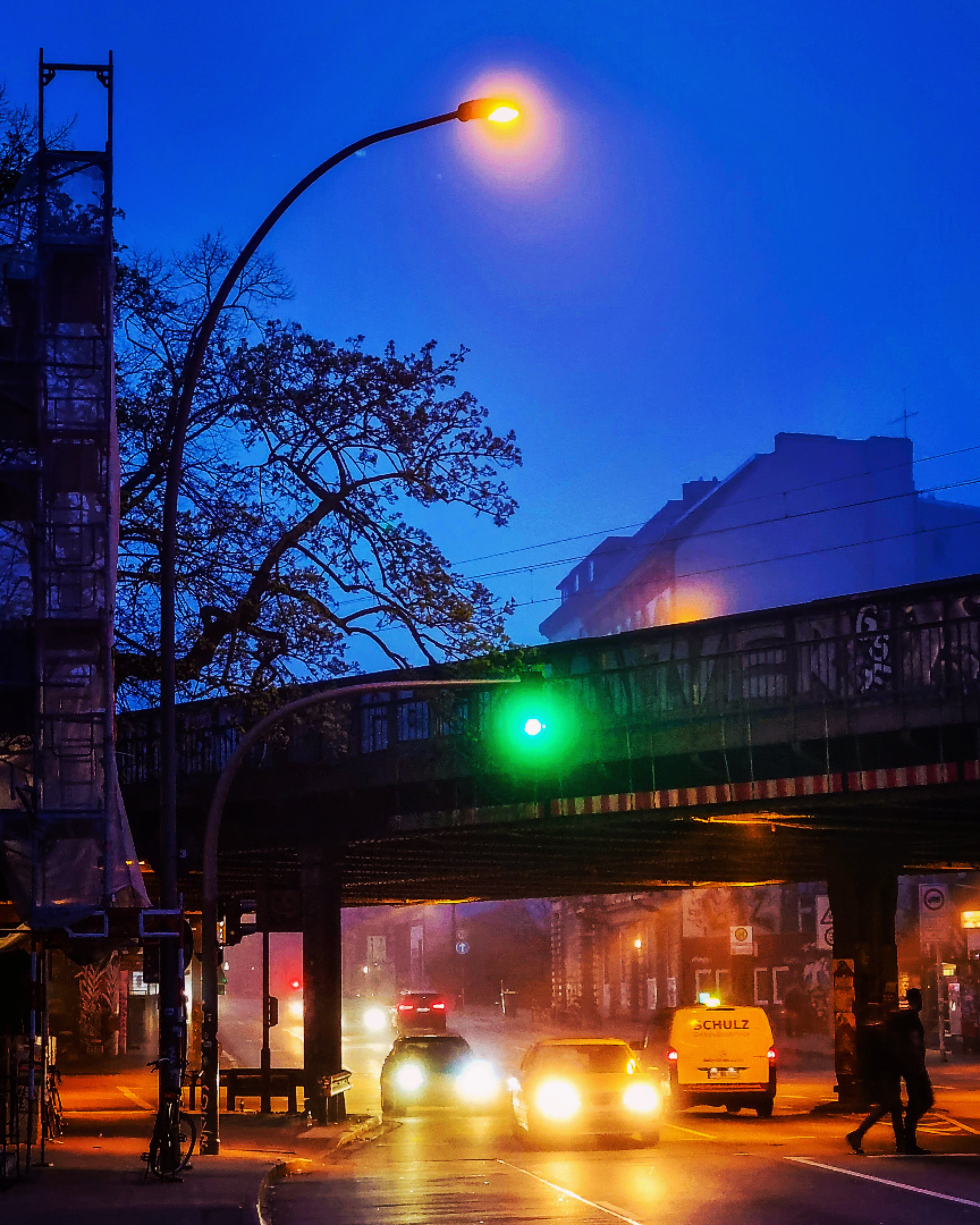
Outside, we tried to cross the street. Red light. Completely empty road. Eight in the morning, not a car in any direction, just two grown adults standing on a curb in a city of four million people. My friend looked left. Looked right. Looked at me. I shook my head. Don't. He'd lived in three countries. He understood jaywalking. But I had been in Berlin long enough to understand something more important: you do not cross on red here, not because of traffic, but because of other pedestrians. They are watching. They are always watching. And they take this personally. He stepped off the curb anyway. From behind us, a voice — a man, elderly, with the authority of someone who has been personally responsible for upholding civilization since 1987 — bellowed: "HALT! Denken Sie an die Kinder!" — Stop! Think of the children. We both looked around. There were no children. It was eight in the morning on a Wednesday. The only living things on that street were us, the man, two pigeons, and a cyclist who'd already looked away in disgust. My friend stepped back onto the curb. We stood there in silence until the light turned green. "How long have you lived here?" he asked. "Two years." "And this still happens to you?" "I don't jaywalk anymore," I said. "It's not worth it." He looked at me like I had been slightly broken by this city. Which, honestly, is not inaccurate.
The friendliest person we met all morning was a man with a shopping cart full of empty bottles. He saw us coming out of a U-Bahn station, clearly tourist-adjacent, and gave us a genuine, beaming smile. "Danke, Jungs!" — Thanks, guys! My friend was delighted. "Finally! A friendly local!" "He's not thanking us," I said. "He's thanking the general public for generating recyclable material. He's a professional." What I then had to explain — and this took longer than expected — is the German bottle deposit system. Every plastic bottle, every glass bottle: twenty-five cents, redeemable at a machine inside the supermarket. A machine. You put your bottles in, it counts them, it gives you a receipt, you spend the receipt on more bottles, the cycle continues, the earth is saved, Germany is pleased. My friend stood in front of the machine for five minutes. "This," he said, "is the only ATM I've ever trusted."
For lunch we had both. Not either/or — both. This was my friend's idea and I want to be clear: I knew it was excessive and I suggested moderation and I was overruled, and I have no regrets whatsoever. Currywurst: sliced vegan sausage — yes Berlin is cool with anything vegan, then curry ketchup, curry powder on top. A Berlin institution. The food of construction workers and tourists and hungover people and, as of today, visiting comedians. Döner: the other Berlin institution. Beef or chicken, or mixed, in bread that is better than any bread you've had anywhere, with sauces and salad — and always one should say — yes — when asked — salad alles? Ja, genau. And with that big portion of Salad — you will genuinely feel taken care of!
He had a show in Hamburg that night. This was the plan: enjoy Berlin in the morning, take the afternoon flight, arrive with time to spare, have a calm dinner, do the show. Simple. Civilized. Optimistic. Nothing can go wrong — even remotely.
I am an expat and so I proudly use Deutsche Bahn — the famous German public railway network. I have learned, through a ton of unexpected and expected adventures, to check the DB app obsessively, to have all the backup routes memorized like an old grandparent remembers the good old days, to carry a bag full of snacks and a fully charged phone. And of course to emotionally prepare for the outcomes the app politely calls a "minor delay" — the ones that translate into "you'll see your destination tomorrow — thank you for traveling with Deutsche Bahn!" Without exception — I had just done all of that.
I checked the app at 10 AM. Flight: on time. I checked it at 11. Still on time. 12:30, heading to the airport to catch our originally booked flight — and here is where Germany looked us in the eyes and decided we needed more material.
Strike. Not a surprise strike. A scheduled strike. The unions had announced it the previous week, with a start time and an end time, like an event you'd add to Google Calendar. Yes, how could I have overlooked that! Airline strike: Tuesday, 06:00–18:00. Dress code: frustrated. The woman at the check-in desk was, I have to say, remarkably calm about it. "Your flight is cancelled," she said. "What are our options?" "The train." She said it the way a doctor recommends rest. This is what you'll do. This is what's happening now. We're moving on. "Is there anything else—" She started laughing. Not at us, exactly. More at the situation. The laugh of someone who had said take the train forty-seven times that day and found it funnier each time. We took the train.
Two first-class tickets. €280 each. I tell you this not to complain — I've accepted that train travel in Germany requires a payment that exists somewhere between "long-distance transport" and "tribute to a force you cannot control" — but to establish the expectation we arrived at the station with. First class. We thought: clean seats. Quiet carriage. A table. Coffee from the dining car. A civilized journey through northern Germany while we worked on set lists and complained about the bakery woman. The board said: Platform 7. We went to Platform 7. The announcement came: "This train will now depart from Platform 13." I have watched this happen before. I have watched it happen to myself, multiple times. And yet every time, there is a moment — just a moment — of pure collective disbelief across a German train platform, followed immediately by everyone picking up their bags and running. A thousand people. Running. Through a train station. With luggage. Efficiently, I'll grant them that — no shoving, no chaos, just a thousand individuals all arriving at the same terrible conclusion at the same time and acting on it immediately. We made it. My friend, to his credit, is faster than he looks.
On Platform 13: "Attention passengers: today's train has a modified carriage sequence." My friend looked at me. "What does that mean?" "I don't know," I said. "Nobody knows. It's one of those announcements that exists to create the feeling of information without providing any." A man next to us confirmed this. He said, with the thousand-yard stare of a veteran: "Das versteht niemand. Renn einfach." — Nobody understands it. Just run. We ran.
Carriage 7. Seats 81 and 82. This is what it said on our tickets, what we had paid for, what was reserved under our names in the Deutsche Bahn system. The train had: carriages 1, 2, 3, 4, 5, 6, and then, after a small existential pause, carriage 9. I walked the length of the train twice. Carriage 7 did not exist. I want to be very clear: this was not a case of carriage 7 being at the other end, or numbered differently, or hidden in some German bureaucratic logic that I, as a foreigner, simply hadn't unlocked yet. Carriage 7 was not on the train. Carriage 7 has possibly never been on this train. Carriage 7 may be a theoretical construct, like a number on a form that refers to a category of thing that is no longer offered. My friend stared at his ticket. Then at me. "You've been here two years." "I know." "You took this train before." "I know." "And carriage seven—" "Has never existed. I think. I'm still not sure. Get in carriage five."
The air conditioning was broken. Outside: twelve degrees. Grey, light drizzle, the standard north German backdrop. Inside our carriage: approximately thirty degrees and the kind of stale warmth that makes you feel like you're being gently composted. The Germans around us did not complain. This is something I've learned to find genuinely admirable. There is a kind of silent, dignified suffering that is very specifically German — a micro-expression that says this is suboptimal and I have noted it internally and I will tell exactly nobody — and the carriage was full of it. You know, Germans have a word for everything — and one of my favorites is — Schadenfreude — since everyone else is suffering here, they have nothing to complain about — so maybe they are just maliciously happy inside.
My friend, who is from a culture where you absolutely do complain, tried to catch my eye to coordinate a joint grievance. I shook my head. He mouthed: it is so hot. I mouthed: I know. We sat in silent complicity while everyone else sat in silent stoicism and the train rolled north through a beautiful country that was, at that moment, slowly roasting us.
The WiFi lasted three minutes. Three minutes of hope, then nothing, then a little spinning wheel that never stopped spinning, then the quiet acceptance that we were going to spend the next two hours with our own thoughts in a heated carriage with no coffee, because the dining car— The dining car had warm beer and no explanations. I bought two. My friend bought three. He held on to his, looked at it for a long moment, then drank it, kein prost! "Is this a normal train?" he asked. "This is a first-class ticket," I said. He nodded slowly. "Right!"
The conductor was the best part of the whole journey. He came through to check tickets, noticed us, heard us attempt a sentence in German, and immediately became a different person — warm, delighted, slightly mischievous. "Sagen Sie mal: Eichhörnchen." — Say: squirrel. My friend went first. He'd been practicing German sounds all day — the bakery, the apology to the elderly man at the crossing, a very committed attempt to order currywurst, the Salad mit alles — and he had some confidence built up. "Eichhörnchen!" The conductor pointed at him. "Sie dürfen bleiben." — You may stay. Then he looked at me. The expat. The one who has been here two years. I have tried to say this word before. I have tried in private, in the shower, with a German friend coaching me, once with a voice recorder so I could hear what was going wrong. What comes out of my mouth is not German. It's not Bavarian either. It is not any language in the universe. It is something between a sneeze and a question. "Eikh... Eykhör... Eggs—" The conductor said: "Back to wherever you came from." I had to explain that I live here. That I pay rent here. That I use the word Kiez correctly and I've stopped saying Fahrrad like it has three syllables and I know not to cross at a red light, I know, I've learned— He let me stay. I think out of pity. My friend did not stop laughing until Hanover.
We had to change in Hanover. The connection had a twenty-minute delay. Then forty. Then the board updated to a word I've learned to dread: Entfällt. Cancelled. Now — a new word entered my vocabulary. My friend made me say it three times. Schienenersatzverkehr. Rail replacement transport. It means bus. It is twenty-two letters. The Germans have given a bus twenty-two letters because it is a replacement for something better and that deserves to be linguistically acknowledged. We did not take the Schienenersatzverkehr. We found a regional train. The slow one — the one that stops at every village, every town, every cluster of three houses that once petitioned for a platform and got it and have been quietly vindicated ever since. And something happened on that train that I didn't expect. Everyone started talking. Not to us, at first — to each other. Two strangers sharing the same carriage suddenly discovered a common language, which turned out to be: Deutsche Bahn, again, can you believe it. "Platform 13 — of course!" "Last week they cancelled the 14:32 — Hanover to Hamburg — three days in a row!" "Don't get me started on carriage seven—" I pointed at my friend. "CARRIAGE SEVEN." The man across from us clasped my hand like we'd survived something together. We stayed in that carriage for an hour and talked to more Germans than I had in two combined years of living there. They were funny, and warm, and deeply, passionately annoyed — and somehow that combination felt more like home than anything else that day.
We arrived in Hamburg at 7:58 PM. The show was at 8. We ran. It was raining. It is always raining in Hamburg — the city exists in a permanent state of light-to-moderate precipitation, occasionally upgraded to serious precipitation, occasionally downgraded to technically not raining but you'll still get wet. I didn't have an umbrella because I'd left it on the last delayed train in a different chapter of this story. Two minutes after leaving the station we were completely soaked. A taxi driver pulled up. Looked at us. Two drenched men with suitcases, running, not entirely sure where they were going. He said: "Moin." I have lived in Berlin. Berlin says Hallo. Berlin occasionally says Na? — which means everything and nothing simultaneously. But Hamburg says Moin, and only Moin, at all hours of the day, and it contains within that single syllable everything a Northern German is willing to offer you emotionally. I, soaking wet, slightly unhinged from eight hours of trains, said: "Moin Moin!" The driver looked at me. "Sie reden zu viel." — You talk too much. My friend, from the backseat: "He's been here two years." The driver nodded, in the way of someone who now understood everything.
We passed the Elbphilharmonie on the way. It's extraordinary — this wave of glass and steel sitting on the harbor, one of the most beautiful concert halls in the world. I made my friend look up from his phone. "That," I said, "cost 800 million euros and took ten years to build." He looked at it. Then at me. "How long was it supposed to take?" "Four years." He thought about this. "So it's like a train," he said. "But a building." "Germany," I said, "contains multitudes."
We made it. Wet, delayed, suitcases in hand, slightly radicalized by the experience of public transit — but we made it. Two minutes before eight o'clock, in a sold-out venue, in a city that had been raining on us, personally, since we arrived. And I'll tell you something: the show was brilliant. My friend — still not famous enough that you'd know his name, but I'm keeping it that way for now because it makes this story better — was excellent. Loose, energized, funny in the way that only someone who has genuinely had a terrible day can be funny. Afterwards, in the bar, he said: "I need to do a bit about the bakery woman." "The bottle ATM," I said. "The squirrel word," he said. "Carriage seven," I said. "The man who told me to think of the children." We ordered two more beers — warm, as it turned out; the bar was also having an evening — and started writing.
The train back to Berlin the next morning? Already delayed. It hadn't left yet. The departure was nine hours away. And the app had already, cheerfully, updated the status to: fifteen minutes late. I showed my friend the notification. He stared at it for a long time. Then, slowly, the smile of a man who has found his next hour of material. "Same time next year?" he said. I'm already checking the app.
The carriage 7 mystery remains unsolved. The bakery woman has still never smiled. The elderly crosswalk man is, presumably, still out there. And somewhere in the Deutsche Bahn system, there is a seat — number 82, carriage 7 — that is reserved, paid for, and has never once been sat in. It is, without doubt, the most German thing one could have ever encountered. My friend was genuinely lucky to have it all — in one fine German day.