Tales
No teacher No teaching
Half a fool, half a field — the weeds knew what to yield.
August 6, 2026 · 11 min read
There was once an ordinary farmer who lived a quiet life in a small village. He was not a wise man, not a sage, not a teacher. He was just a man who worked the land and gave advice when neighbors asked — the way some men whistle. He hardly noticed he was doing it.
One hot summer morning, a group of people passed by his field on their way to the village doctor. They stopped at a bench on his farmland to rest. Among them sat an elderly woman, pale and unwell.
The farmer had just finished breakfast and was about to plow his field. He saw them and asked what was happening.
They told him the old woman had been sick for a month. They were taking her to see the doctor.
The farmer, as was his habit, offered some advice. He mentioned a certain herb that might help.
Others in the group spoke of their own ailments. The farmer had a remedy for each. Nobody had asked him for one. That had never stopped him before.
They went on to the doctor. The doctor shook his head. There was no cure for such oldness, he said. It was natural.
But the old woman followed the farmer's advice anyway. And to everyone's surprise — the farmer's most of all — she recovered within a few weeks.
The rest of the group tried the same remedies. They too got better.
Rumors began to spread through the village. This farmer, they said, was better than the doctor. The doctor, it should be said, did not care for this rumor.
More people came. Some spoke of farming troubles. Some of marriage. Some of money. Some of health. Some of what they could not name.
At first, the farmer gave advice freely. He spent more time helping others than tending his fields.
Now, there was always a fifty-fifty chance that any advice might work. The farmer was simply lucky, all the time. But luck built a reputation. And rumor turned him into a sage.
"I am no teacher," the farmer said. "I have no teaching. No more advice."
People nodded. "How humble," they whispered. "How truly wise." He must be the wisest man alive, they said. Who else could reject fame so completely?
Then one day, the farmer began to give wrong answers on purpose. He spoke in riddles. He said nonsense in paradoxical ways. He joked with consciousness itself. If wisdom would not leave him alone, he decided, wisdom could at least have some fun.
---
There was a woman in the village who could not stop worrying. She worried aloud from morning to night, and she complained of her worries to anyone who passed. She lost her sleep. Her family fled the house. Soon the whole village walked the other way when they saw her coming.
The farmer told her: "Each morning, find the first crow you see. Feed it a little of your own food, and tell your worries to it. When the crow is well fed, its blessing will heal you."
She did as he said. The crow listened and never once walked away. By the time it was fed and had heard everything, the day's worries were already spoken, and she found she did not need to say them twice. Within a month she slept through the night.
The crow grew fat and glossy, and still it flew — a little heavier each morning — circling her roof at dawn like a small black priest waiting for confession. And the village noticed that a woman followed everywhere by a well-fed crow is a woman people stop and talk to.
Two brothers came next, fighting over their dead father's land. Each claimed the bigger half. The farmer said: "Let one brother divide the land. Let the other choose first."
They stared at him. It sounded like a trick. It was.
The elder brother divided the land so carefully, so fairly — measuring by rope, by footstep, by the shade of every tree — that the two halves came out equal to the last stone. The quarrel ended, because there was nothing left to win. At the harvest feast the brothers sat side by side, each secretly certain he had gotten the better half.
Then a young man came who could not decide: stay in the village, or leave for the city. He had been deciding for three years. The farmer said: "Flip a coin. But do not look at it."
The young man flipped the coin and clapped his hand over it. And in that one instant, while the coin lay hidden, he felt his own heart leap toward the road. He left the coin unturned on the farmer's bench and went home to pack.
The farmer kept the coin. It seemed only fair.
---
And so his fifty-fifty chance flipped. His nonsense became sense one hundred percent of the time.
To the farmer, this was the next level of mystery. He stopped trying to understand it. He began to speak whatever came, intuitively, without thought.
This went on for five long years.
His neighbors grew tired of strangers visiting daily. His wife and children suffered. The farming lost its profit.
They placed a donation box in front of the house.
In the end, the farmer earned more from donations than from his crops.
But listening to everyone's problems all day was not easy. He felt too much. So one day, he decided to quit. He would return to farming.
He put a sign on his house:
No More Advice.
Visitors came. He kept his silence. Slowly, people lost their faith and interest. The allure faded, quietly.
This lasted one year. He returned to his old farming routine.
But he began to miss it.
One early morning, a man came to visit him. He was the son of the old woman — the very first one, the one the farmer had advised on the bench. She had died, and the family hoped he would attend the funeral, for she had always been very fond of him.
So he went, with deep sadness and a sense of bonding.
At the funeral, people praised him. They spoke of how his advice had changed their lives. Some had gotten better financially. Some had found peace. Some had simply felt less alone.
The farmer thought — This must be God's will. I must start helping people again.
He took it up as a good deed. He finally believed he could truly help people — a divine duty he must perform sincerely.
So he started again.
For another year, it went mostly well.
Then, slowly, the chances began to flip back. It became fifty-fifty, mostly. Some got better; for others, his advice did nothing. People still kept their faith. He tried harder to help those who could not be helped.
The more he tried, the more logical and sensible his advice became. People could follow his reasoning now. But nothing worked like before.
Even the same advice that had worked for one person did not work for another.
The farmer grew distressed.
Some people lost money. Some got sick. Some suffered more than before.
After several years, the charm wore off. Rumors spread. He was a fake. A con man. He had made a business out of people's suffering.
This destroyed the inner strength of the once-humble farmer. He did not understand. He had spoken from his heart. He had only wanted to do good. Why was God punishing him?
He put out the old sign again:
No More Advice.
Eleven years had passed since he first began giving advice to everyone who came. He was old now. Getting back to farming was hard, and he was full of doubt — somewhere along the way, perhaps, he had lost that art as well. He asked his son to help.
Together, they returned to the old farming routine.
Spring came.
The farmer tried very hard to get the best from the season. He planted all kinds of crops. He took so much care. He never let his eyes leave the fields.
"We must have a good harvest this season," he told his son. "Otherwise we will have a hard time surviving the coming winter."
The corn needed water once a week. But he came every second day, his hands shaking with worry. The roots grew weak, drowning in water that had nowhere to go. The stalks turned yellow at the base, soft and rotting where they should have been strong.
The mustard needed thin sowing and lean soil. But he sowed it thick and fed it rich, afraid the rows would come up bare. It grew all leaf and no flower, a green thicket crowding itself into its own shade.
The beans needed space to climb. But he planted them too close. The vines grew in knots, almost fruitless.
The tomatoes needed sun. But he covered them with cloth at the first sign of heat, afraid the sun would burn them. They grew pale and weak, the fruit small and watery.
He checked the soil every morning. He counted the leaves. He pulled out any weed that dared to grow near his precious plants. He talked to them as he worked, telling them to grow, to be strong.
His son watched in silence.
The neighbor's fields, far away, grew tall and green. The neighbor did not come every day. He watered when the leaves drooped. He let the weeds grow between the rows. He trusted the rain.
The farmer did not understand.
Spring passed into summer. Already it was clear: the harvest would be half of what it used to be.
The farmer sat alone in the field at dusk. The sun was going down. The sky was orange and pink. The air was still.
He looked at his corn. Some stood tall. Some lay flat. The ones he had watered most were the weakest.
He walked to the edge of the field, where he had not planted anything. Where he had not touched the soil.
There, a beautiful patch of wildflowers had grown. Red poppies, full of life. Beside them, vines of wild beans, wrapped in blue flowers. He had not watered them. He had not pulled the weeds around them. He had not checked on them a single day. Yet they were the most alive plants in his entire field.
He sat down quietly beside them. He did not move. He did not speak.
The wind blew. The flowers swayed.
He looked at his hands. They were tired from work. They were shaking.
He thought of the old days. Before the advice. Before the fame. Before he knew he was helping people. He used to plant the seeds. He used to water when he remembered. He used to walk through the fields and smile. He did not count the leaves. He did not measure the water. He did not tell the plants what to do.
He let them grow.
And they grew.
Now he had changed. Everything he did, he wanted it to be good. He wanted to be a good farmer. He wanted a good harvest. He wanted to survive the winter. He wanted to be right in all of his craft. How needy he had become, how full of longing for a good outcome!
The wind breathed gently through the flowers.
He stood up. He walked back to the house.
The next morning, he did not water the corn. He let the soil dry. He walked through the fields and looked at the plants. He did not pull the weeds. He did not count the leaves. He did not measure the water.
He picked up his hoe. He began to work. But he worked slowly. He worked without worry. He worked with joy, careless of whatever might come.
He told his son, "Let the plants be. We have done enough."
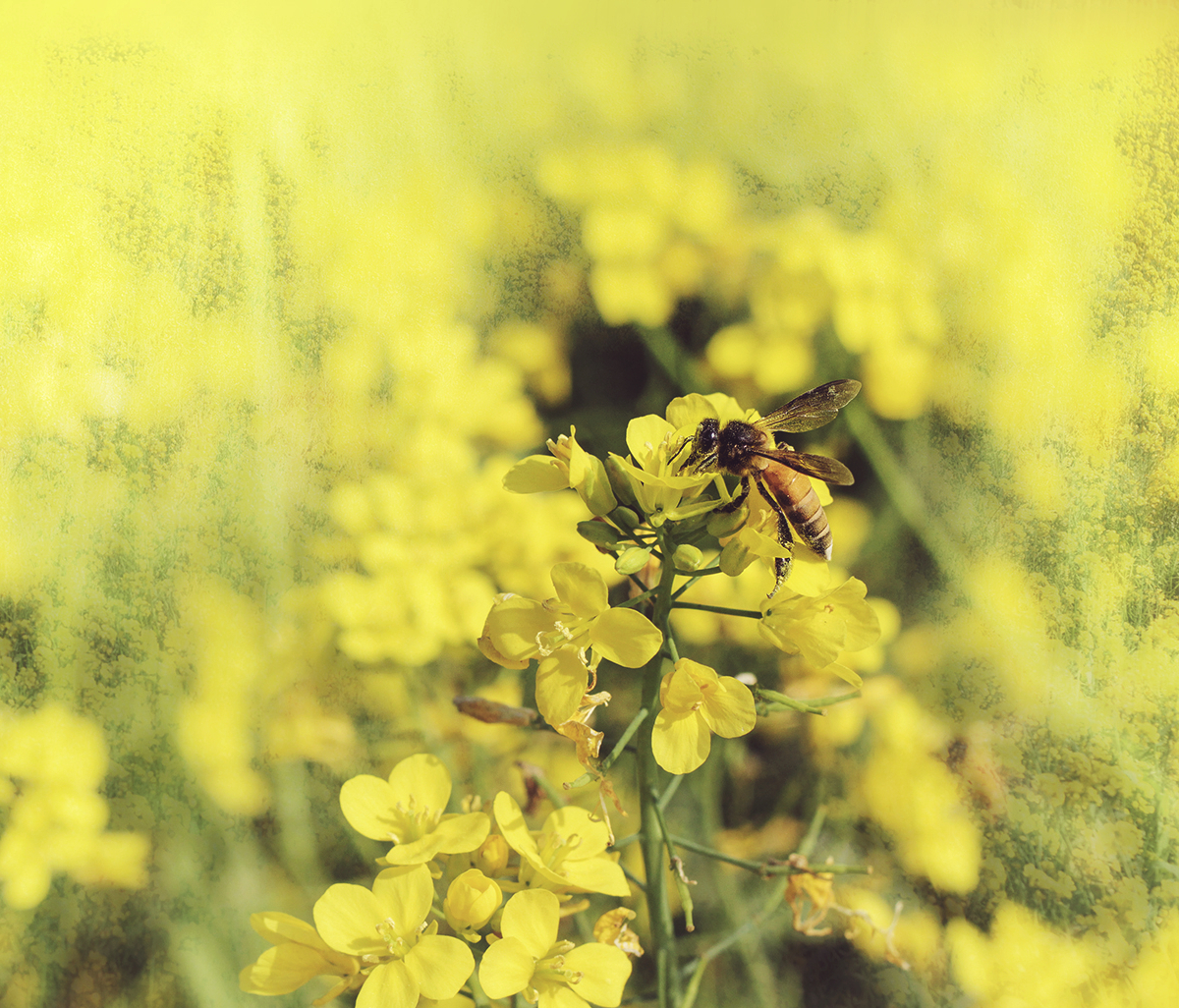
Weeks later, he woke before the sun and took a slow, long walk through the mustard field. It had flowered while he was not watching, and now the flowers stood still and the light came gently, until the whole field melted into a bright golden canvas. He did not look for what was failing. He simply walked, and let the flowers caress his hands as he passed, and somewhere in that silence he stopped keeping count of anything at all.
Bees danced from petal to petal. They did not notice him at all.
When he came back to the yard, the sun was fully up. His heart was filled with such a subtle yet overwhelming joy that when his eyes fell on the forgotten sign by the door, he almost could not remember why he had put it there in the first place.
With a sudden strong urge, he walked to the backyard, grabbed a bucket of paint, and wrote a few lines:
There is no teacher. There is no teaching. Come as you please — but there is no promise.
6.8.2026 — 8:40 am | 31812 DE